Percent Decrease Calculator
Use this free percent decrease calculator to instantly find the percentage decrease between two values. Enter your original and new value below to get started.
How to Use This Calculator
Here is exactly how to use this percent decrease calculator in three steps.
Step 1 — Enter the original value
This is your starting point — the original value before any percentage decrease. The price before the discount. Your old salary. Last month's bills. Type it into the first box.
Step 2 — Enter the new value
This is the number after the drop. The sale price. Your new salary. This month's lower expenses. Type it into the second box.
Step 3 — Click calculate
That is all. The tool will calculate the percentage drop instantly.
What you will see
A clear percentage decrease. Something like "25% decrease." Plus the exact difference between the two numbers, shown as a negative like "−50".
What if you mix up the order?
The calculator checks for that. If you put the smaller number first and the larger number second, it will notice and point you to the Percent Increase Calculator. That tool handles growth.
Reverse calculation
Here is something handy — this tool also supports reverse percentage decrease calculation. If you know the original number and the percentage you want to take off, you can work backwards. For example, "decrease 100 by 20% and get 80." I will show you the formula in a bit.
What Does Percentage Decrease Actually Measure?
Here is the simple version of what percentage decrease means. Percentage decrease tells you how much something shrank, compared to where it started. One question: "How big was the relative percentage drop compared to the original?"
Let me show you why that question matters.
A business loses $10,000. Sounds bad. But without knowing the starting point, you have no idea how bad. If the business started with $20,000, losing $10,000 means it lost half of everything. That is a 50% decrease. If the business started with $10,000,000, losing $10,000 is only a 0.1% decrease. That is nothing.
Same loss. Completely different story. This is why percentage decrease matters in real life. Percentage decrease tells you which story you are in.
Breaking Down the Percent Decrease Formula
The Formula
Here is the percent decrease formula. It looks like the increase formula, but there is one important difference.
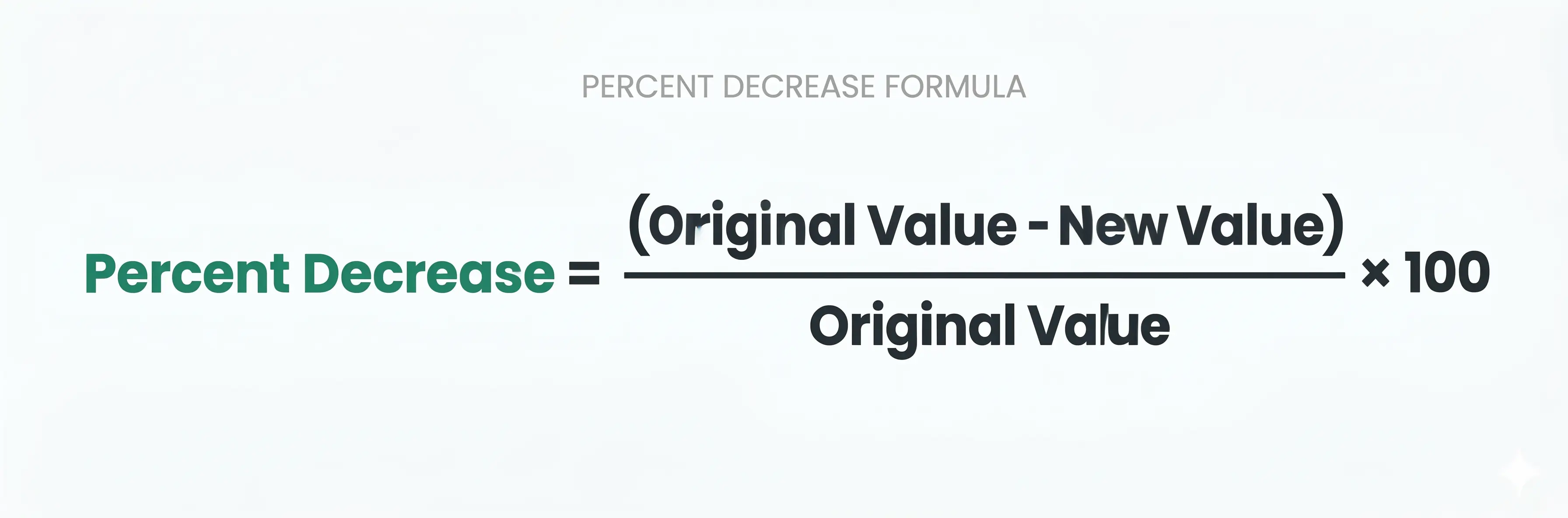
Here is how to calculate percentage decrease step by step. Notice the subtraction — increase uses new minus original. Decrease uses original minus new. That is on purpose.
Why the Subtraction Order Matters
When something goes down, the original number is bigger than the new number. So original minus new gives you a positive number. That is the amount of the decrease. Exactly what you want.
If you accidentally do new minus original, you get a negative number. Then you divide. Then you multiply. You end up with a negative percentage. That is mathematically correct — a negative does tell you there was a decrease. But it looks wrong. Most people expect a positive number when talking about a drop. So the formula flips the subtraction to keep things clean. Getting this wrong is the most common mistake I see. Always do original minus new for percentage decrease.
Worked Formula Example
Here is a percentage decrease formula example. A product costs $100. Then it goes on sale for $75.
(100 − 75) / 100 × 100 = 25 / 100 × 100 = 25%
That is a 25% decrease. You saved a quarter of the original price.
How to Decrease a Number by a Known Percentage
Here is how to decrease a number by a percentage when you already know the rate. Sometimes you have the original number and the percentage you want to take off. You need the new number. For example, "What is $80 after a 15% decrease?"
Here is the formula:
For $80 with a 15% decrease: $80 decreased by 15% to $68.
You see this percentage decrease formula for discounts, pay cuts, and budget reductions all the time.
How to Work Backwards — Finding the Original Value
This section is only on this page. People ask me this all the time — how to find the original price after a percentage decrease. "I know the sale price and the discount percentage. What was the original price?"
Here is the reverse percentage decrease formula:
Retail example. You buy a jacket on sale for $68. The tag says it was 15% off. Original price: $68 / (1 − 15 / 100) = $80. You saved $12.
Finance example. You get a paycheck for $3,400 after taxes. Your tax rate is 15%. That means you earned $4,000 before taxes. You lost $600.
Percentage Decrease — 5 Worked Examples
Here are five percentage decrease examples from real life. Same formula each time.
Example 1 — Retail discount
A laptop costs $120. It goes on sale for $84.
The laptop is 30% off.
Example 2 — Salary reduction
Use this to calculate percentage decrease in salary. You made $55,000. Then your pay drops to $49,500.
Your salary decreased by 10%.
Example 3 — Business operating costs
Monthly costs were $18,000. You find a cheaper supplier. Costs drop to $14,400.
Costs decreased by 20%.
Example 4 — Investment portfolio loss
Here is how to track percentage decrease in an investment portfolio. Your portfolio was $25,000. The market dips. It drops to $19,500.
You lost 22%.
Example 5 — Weight loss
This formula also shows how to calculate weight loss percentage. You weigh 210 pounds. After a few months, you weigh 189 pounds.
You lost 10% of your body weight.
Where Percentage Decrease Is Used in Real Life
Here are the most common percentage decrease in real life examples.
Retail discounts
You see "30% off." Do the math yourself. Original minus sale, divided by original, times 100. If the numbers do not match, the sign is wrong.
Tax and after-tax income
This is how you calculate percentage decrease in income after tax. You make $60,000. You take home $48,000.
You lose 20% to taxes.
Asset depreciation
The same formula works as a car depreciation percentage calculator. You buy a car for $28,000. Five years later it is worth $16,800.
Your car lost 40% of its value. Learn more about depreciation.
Energy reduction
You can also track percentage decrease in energy bills. Your electric bill was $200. You make some changes. It drops to $160.
You cut your usage by 20%.
Inflation impact
Inflation at 5% means your money buys about 5% less. Economists track GDP drops and unemployment rises using percentages. It is the only fair way to compare across different countries and time periods.
Percentage Decrease vs. Percentage Change vs. Percentage Points
People confuse percentage decrease vs percentage change all the time. Let me clear it up.
Percentage decrease
Only for when numbers go down. Formula: ((Original − New) / Original) × 100. The answer is positive.
Percentage change
Works for both up and down. Formula: ((New − Original) / Original) × 100. For a decrease, the answer is negative. For an increase, it is positive.
Percentage points
Measure the raw gap between two percentages. Example: Interest rate drops from 5% to 4%. That is a 1 percentage point drop. But the percentage decrease is (5 − 4) / 5 × 100 = 20%. Both are correct. They answer different questions. That is the key difference between percentage points and percentage decrease.
If someone says "rates dropped by 1%," ask them: "One percentage point or one percent?" The difference matters for mortgages, loans, and investments.
Tracking Percentage Decrease Over Time
The same formula works when you need to track percentage decrease over time. You buy a car for $28,000. Five years later it is worth $16,800.
You can track monthly declines too. Revenue drops from $50,000 to $45,000. That is a 10% monthly decrease. Catching these early helps you fix problems before they get worse.
A serious warning. Here is how to calculate total percentage decrease over multiple periods — do not average them. If revenue drops 10% in January and another 10% in February, the total decrease is not 20%. It is 19%. Why? Because the second 10% applies to a smaller number. Always use the start and end values to calculate total decline. Ignore the middle.
Common Mistakes When Calculating Percentage Decrease
Here are the most common percentage decrease mistakes and how to avoid them.
Mistake 1 — Dividing by the new value instead of the original
From $100 to $75. This is the most common percentage decrease wrong formula error — always divide by the original.
❌ Wrong: 25 / 75 = 33%
✓ Right: 25 / 100 = 25%
Mistake 2 — Reversing the subtraction order
For decrease, always do original minus new. New minus original gives you a negative. Avoid the confusion. Keep it positive.
Mistake 3 — Forgetting to multiply by 100
You subtract. You divide. You get 0.25. That is not a percentage — it is a percentage decrease decimal. Multiply by 100. Get 25%.
Mistake 4 — Confusing percentage decrease with percentage points
From 5% to 4% is a 1 percentage point drop. It is also a 20% percentage decrease. Know which one you are talking about.
Mistake 5 — Averaging percentage decreases across periods
Use start and end values only. Do not average. It gives the wrong answer.
FAQ — Frequently Asked Questions
What is the formula for percentage decrease?
((Original Value − New Value) / Original Value) × 100.
How do I calculate the percentage decrease in Excel?
Put original in A1, new in B1. Use =(A1−B1)/A1. Then format the cell as a percentage.
What is the difference between percentage decrease and percentage change?
Percentage decrease only applies when numbers go down. Percentage change works for both, but the result is negative for decreases.
How do I decrease a number by a specific percentage?
New Value = Original Value × (1 − Percentage / 100). Example: $100 decreased by 20% = $80.
What is the difference between percentage decrease and percentage points?
Percentage decrease measures relative shrinkage. Percentage points measure the raw gap. A drop from 5% to 4% is a 1 percentage point drop but a 20% percentage decrease.
How do I find the original value before a percentage decrease?
Original Value = New Value / (1 − Percentage / 100). Example: You paid $68 after a 15% discount. Original price was $80.
Can percentage decrease exceed 100%?
Yes. From 100 to 0 is 100%. From 100 to −50 is 150%. But for most everyday situations — prices, salaries, weights — it stays between 0% and 100%.
How do I track percentage decrease over multiple periods?
Use the start and end values only. Do not average percentages. The middle periods do not matter for the total.
Conclusion
Let me bring it back to where we started. That "30% off" sign. That pay cut sounded small. Those investment losses. Raw numbers hide the truth. Percentage decrease reveals it. It tells you not just how much fell, but how much of the original you lost. The formula is simple: original minus new, divided by original, times 100. The calculator at the top does the work for you. Enter two numbers. Click calculate. Get your answer instantly.
If you need to measure growth instead of decline, check out the Percent Increase Calculator or the Scale Calculator. And if you want to see more tools like this, visit the CalCluster homepage.