Right Triangle Calculator – Find Sides, Angles, Area & Perimeter
Enter any 2 known values — sides or angles — and instantly solve the entire triangle.
Enter any 2 values
Fill in any 2 fields. Leave the rest empty.
Results
How we solved this
So Here's The Deal
Right triangles show up far more often in everyday life than most people realize. A shed roof, a bike ramp, a diagonal brace on a gate — all of these are right triangles in disguise.
Here's something most people don't learn in school: you only need two known values to solve an entire right triangle. Just two.
That simple fact is why this right triangle calculator exists. Rather than just spitting out a final answer, it shows the full step-by-step solution — so you can see exactly how each result was calculated.
Enter any two values — sides or angles — and the calculator instantly returns everything: the hypotenuse, both legs, both angles, the area, the perimeter, and even the altitude. Whether you need to solve for hypotenuse, a missing leg, or an unknown angle, this tool handles it instantly.
It's completely free, with no signup, no email, and no credit card required.
Below, you'll find how to use the calculator, a breakdown of the math behind it, and answers to the most common questions people search for.
Real Quick – What Is A Right Triangle?
Before we jump in, let's make sure we're on the same page.
A right triangle is just a triangle with one 90-degree angle. That's it.
The sides have names. The longest one is the hypotenuse. It's always across from the 90-degree corner. The two shorter ones are legs. They meet at the right angle.
That's all you need to know about the hypotenuse and legs to get started.
How To Use This Right Angle Triangle Calculator
I tried to keep it simple. Hate complicated tools.
- Pick degrees or radians. Most people use degrees — 30 degrees, 45 degrees, 60 degrees, that stuff. If you're doing advanced math or physics, you might need radians. Just click the button.
- Type any two numbers. Two sides — like a is 3 and b is 4. Or one side and one angle — like the long side is 10 and the angle alpha is 30 degrees. Important: leave the other boxes empty. The calculator needs exactly two inputs. If you fill three, it gets confused.
- Click Calculate. No tricks. No popups. Just click.
- See what comes back. Eight little boxes with every measurement — including area, perimeter, and altitude. A step-by-step breakdown showing how each number was found. A little picture that changes with your numbers.
- Hit Reset to start over. Clears everything. Fresh start.
One more thing — press Enter after typing a number. Works the same as clicking Calculate.
The Math Behind the Calculator
You don't need to memorize these formulas, but understanding them helps you trust the results.
The Pythagorean Theorem
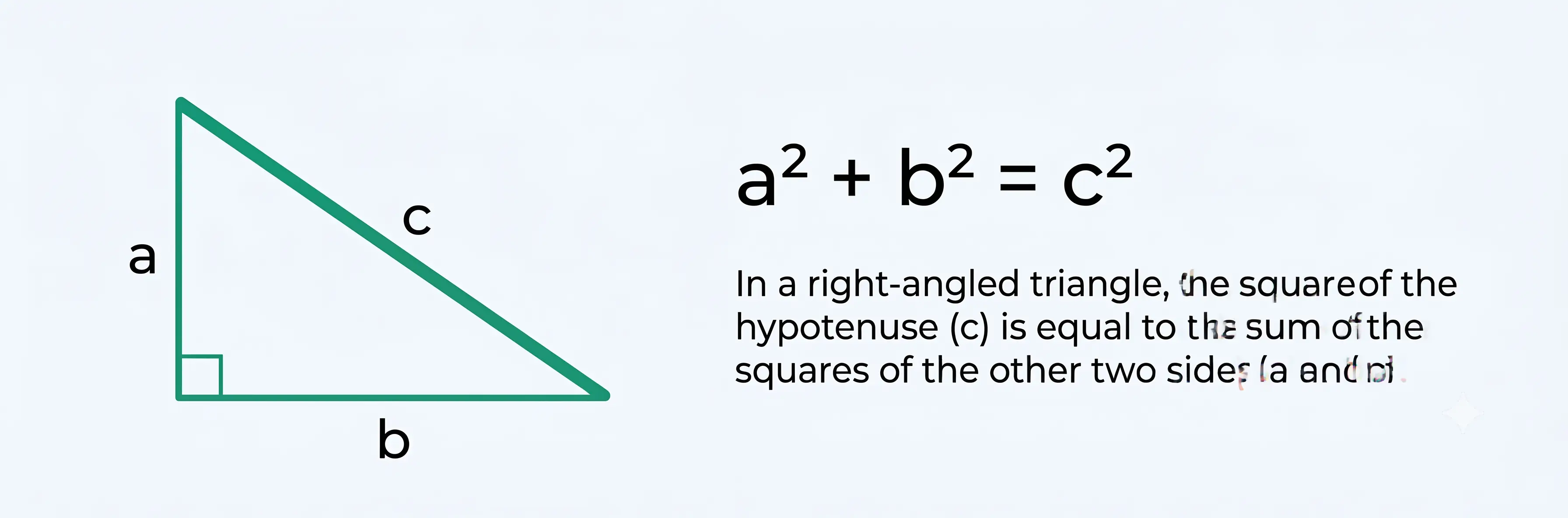
This formula dates back over 2,500 years and remains the foundation of right triangle geometry: a² + b² = c².
Take both legs, square each value, and add them together. This gives you the hypotenuse squared. To find the hypotenuse, take the square root of that sum. To find a missing leg, take the square root of the hypotenuse squared minus the other leg squared.
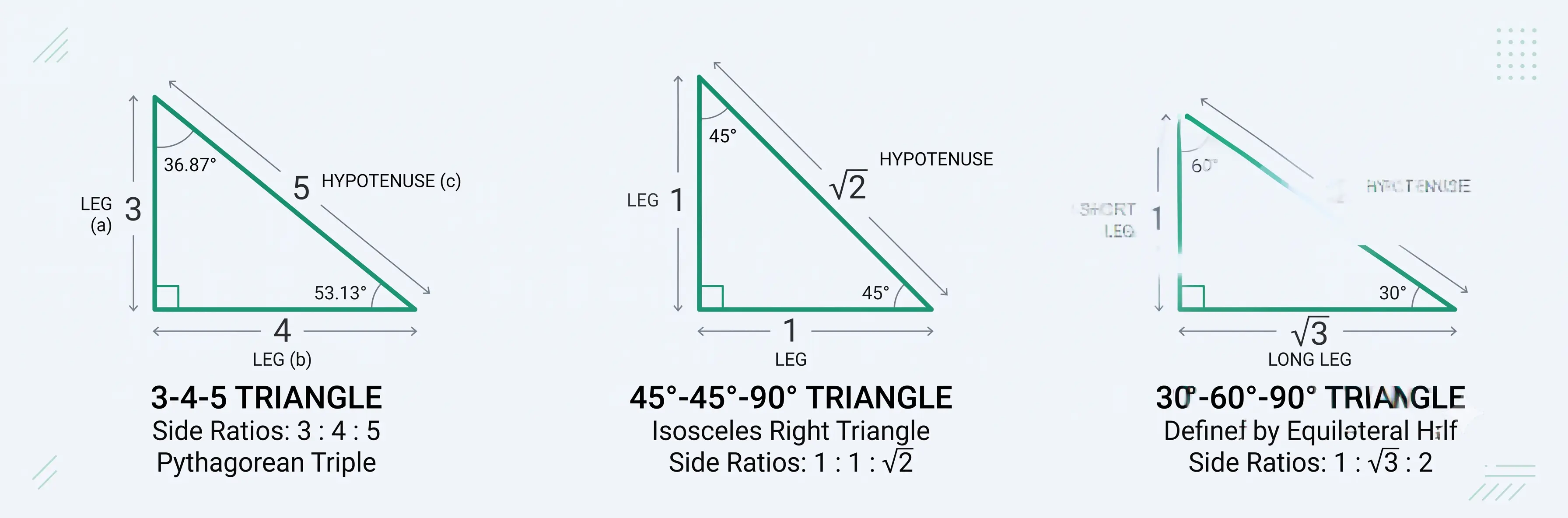
Example: if a = 3 and b = 4, then c = √(9 + 16) = √25 = 5. This is the well-known 3-4-5 right triangle, used by builders for centuries to verify square corners.
Using Sine, Cosine, and Tangent
When only one side and one angle are known, trigonometric ratios — sine, cosine, and tangent — can be used to find the remaining values.
These relationships are commonly remembered using the mnemonic SOH CAH TOA: sine equals the opposite side divided by the hypotenuse, cosine equals the adjacent side divided by the hypotenuse, and tangent equals the opposite side divided by the adjacent side.
For example, if the hypotenuse is 10 and angle α is 30°, then leg a = 10 × sin(30°) = 10 × 0.5 = 5.
Finding Angles Using Inverse Trigonometric Functions
If both sides are known but the angles are not, inverse trigonometric functions — arcsin and arctan — can be used to calculate them.
Take the arcsin of the opposite side divided by the hypotenuse, or the arctan of the opposite side divided by the adjacent side. The remaining angle is then 90° minus the calculated angle, since the two non-right angles in a right triangle always sum to 90°.
Calculating Area, Perimeter, and Altitude of a Right Triangle
Once all three sides are known, the remaining values are simple to calculate.
- Area = (leg a × leg b) ÷ 2
- Perimeter = leg a + leg b + hypotenuse
- Altitude = (leg a × leg b) ÷ hypotenuse — the perpendicular height from the right angle to the hypotenuse
Common Right Triangle Calculations
Below are the most common scenarios this calculator handles, along with worked examples for each.
Finding the Hypotenuse When Both Legs Are Known
Given two legs — for example, leg a = 5 and leg b = 12 — the calculator finds the hypotenuse using c = √(a² + b²).
Example: a wheelchair ramp has a height of 3 feet and a ground distance of 4 feet. The ramp length is √(9 + 16) = √25 = 5 feet.
Finding a Missing Side When the Hypotenuse and One Leg Are Known
Given the hypotenuse and one leg, the calculator finds the remaining leg using a = √(c² − b²).
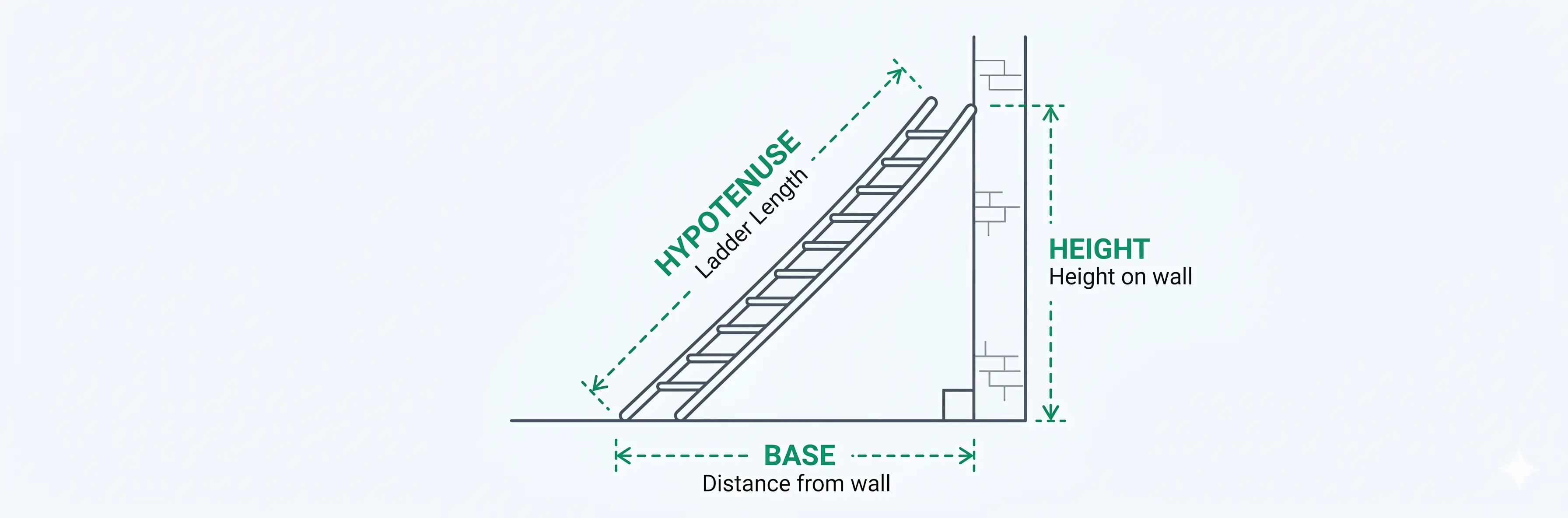
Example: a 13-foot ladder is positioned 5 feet from a wall. The height it reaches is √(169 − 25) = √144 = 12 feet.
Finding the Perimeter of a Right Triangle
The perimeter is simply the sum of all three sides. A 3-4-5 triangle has a perimeter of 12 — useful for estimating material needed around the edges of a project.
Finding Any Side of a Right Triangle
If two sides are known, use the Pythagorean theorem. If one side and one angle are known, use sine, cosine, or tangent.
Finding the Angles of a Right Triangle
The calculator uses arctan or arcsin depending on the known values. For example, if a = 3 and b = 4, then α ≈ 36.87° and β ≈ 53.13°.
Finding the Area of a Right Triangle
The area is calculated by multiplying the two legs and dividing by 2. Legs of 6 and 8 give an area of 24.
Finding the Altitude of a Right Triangle
The altitude is found by multiplying the legs and dividing by the hypotenuse. For a 3-4-5 triangle, the altitude is 12 ÷ 5 = 2.4.
Special Right Triangles the Calculator Detects
When your triangle matches a known special right triangle pattern, the calculator automatically identifies it.
The 45-45-90 Triangle
Both legs are equal in length, with angles of 45°, 45°, and 90°. The sides are always in the ratio 1 : 1 : √2. For example, if each leg is 1, the hypotenuse is approximately 1.414. This triangle appears frequently in tile work, square corners, and computer graphics.
The 30-60-90 Triangle
Angles of 30°, 60°, and 90°, with sides in the ratio 1 : √3 : 2. The shortest leg is opposite the 30° angle. For example, if the short leg is 5, the long leg is approximately 8.66 and the hypotenuse is 10. This triangle is common in roof framing, hexagonal structures, and navigation.
Pythagorean Triples
Pythagorean triples are sets of whole numbers that satisfy a² + b² = c² exactly. The most common is 3-4-5, with others including 5-12-13, 7-24-25, 8-15-17, and 9-40-41. These values appear frequently in textbooks and exams.
Real-Life Applications of Right Triangles
Right triangle formulas are used in everyday life far beyond the classroom. Here are some practical examples where this right triangle calculator comes in handy.
- Construction — squaring corners, framing roofs, and building stairs. A right triangle calculator for construction makes this simple: a 12-foot rafter with a 4-foot rise requires a run of approximately 11.31 feet.
- Navigation — calculating the straight-line distance between two points using right triangle principles.
- Surveying — determining building or tree height by multiplying distance by the tangent of the measured angle. Right triangle calculations are essential in navigation and surveying tasks like these.
- DIY Projects — positioning ramps, ladders, and mounting equipment. A 20-foot ladder placed at a 75° angle reaches approximately 19.3 feet high.
- Electronics — calculating AC circuit impedance.
- Sports — measuring distances such as the diagonal from home plate to second base, approximately 127.3 feet.
- Video Games — 3D games rely on right triangle formulas to calculate distances between characters and objects.
Right Triangle Calculator FAQs: Sides, Angles, Area & More
What is a right triangle calculator online?
A free tool that takes any two known values and instantly calculates everything else — all sides, both angles, area, perimeter, and altitude.
How do I find the hypotenuse when I know both legs?
Enter both legs into the calculator. It uses the Pythagorean theorem: a² + b² = c².
How do I find the perimeter of a right triangle?
Add all three sides together. The calculator does this automatically once all sides are known.
How do I find a missing side of a right triangle?
It depends on what's known. If two sides are known, use the Pythagorean theorem. If one side and one angle are known, use sine, cosine, or tangent.
What is a right-angle triangle?
A triangle with one 90-degree angle. The side opposite that angle, the hypotenuse, is always the longest side.
Can a right triangle have two equal sides?
Yes — this is a 45-45-90 triangle. However, a right triangle cannot have all three sides equal, since that would require 60-degree angles, which contradicts the 90-degree requirement.
What is a 30-60-90 triangle?
A special right triangle with angles of 30°, 60°, and 90°, where the sides follow the ratio 1 : √3 : 2.
What is a 45-45-90 triangle?
A special right triangle with two equal legs, where the sides follow the ratio 1 : 1 : √2.
What is the altitude of a right triangle?
The altitude is the perpendicular distance from the right-angle vertex to the hypotenuse, calculated as h = (a × b) / c.
Does this calculator work in radians?
Yes. Click the Radians toggle and all angle values and results update accordingly.
Is this calculator really free?
Yes. No registration, no email, and no free trial requirements.
Can I use this for homework?
Yes. The step-by-step breakdown shows how each result is derived, which can help with understanding the underlying concepts.
Can I use this for construction or engineering work?
The calculations are mathematically accurate. For critical applications such as structural work, results should be verified by a qualified professional.
Do I need to download anything to use this calculator?
No. It runs entirely in your browser with nothing to install.
What happens if I enter three values?
The calculator will prompt you to enter exactly two values, preventing incorrect or overdetermined results.
What happens if my hypotenuse is shorter than a leg?
The calculator will display an error, since the hypotenuse must always be the longest side of a right triangle.
Can I use this calculator on my phone?
Yes. It works on any phone, tablet, or desktop browser.
Does the calculator store my data?
No. Everything stays in your browser. Privacy matters.
Other Tools You Might Like
- Scale Calculator — for resizing drawings and models.
- Percent Increase Calculator — for markups and raises.
- Percent Decrease Calculator — for discounts and sales.
Final Thoughts
Right triangles don't have to be difficult. Whether you're a student looking for geometry homework help, a contractor using a square a foundation calculator, or a DIYer planning a ramp, this tool is built for you.
Enter any two values and get all eight results in seconds, complete with step-by-step formulas showing exactly how each answer was derived. Special triangles are automatically detected, and the calculator works in both degrees and radians.
This free right triangle calculator with steps requires no registration and no tracking. Try this right triangle calculator online free — enter your values, click Calculate, and get your full solution in less than a second.
Bookmark this page for future reference, and feel free to share it with anyone who could use help with right triangle calculations.