pH Calculator — Calculate pH, pOH, [H+], and [OH-]
Use our free pH calculator to instantly find pH, pOH, [H+], and [OH-]. Supports 4 input modes including mix solutions. Formula shown for every result.
So let's just start with the obvious question — what is an online pH calculator? It's a tool that works out how acidic or basic a solution is. That's it. You give it one input — a hydrogen ion concentration, a hydroxide concentration, or a pH value you've already got written down somewhere — and it returns all four values at once: pH, pOH, [H+], and [OH-]. Now, why does something like this need to exist? Honestly, because pH calculations come up in so many different contexts, and doing the logarithm math from scratch every single time is just tedious. It's not hard exactly, it's just annoying. Chemistry assignments, water treatment verification, reef tank adjustments, homebrewing, soil work, pharmaceutical lab calculations — it keeps showing up. This calculator handles four different modes: from [H+], from a known pH, from [OH-], and from mixing two solutions together. And this is worth saying clearly before anything else — every result shows the actual formula that produced the number, not just the number itself. That's important. A bare answer with no working shown is pretty useless if you're trying to understand what's happening or figure out why something doesn't look right.
What is pH?
pH stands for "potential of hydrogen." It tells you how many hydrogen ions — H⁺ — are dissolved in a solution at any given moment. That count determines whether the solution is acidic, neutral, or basic. The scale itself runs from 0 to 14 under normal conditions — here's the pH scale explained:
| pH Range | Classification | Common Examples |
|---|---|---|
| 0–3 | Strongly Acidic | Battery acid, gastric acid |
| 4–6 | Mildly Acidic | Coffee, rainwater, tomato juice |
| 7 | Neutral | Pure water |
| 8–10 | Mildly Basic | Seawater, baking soda solution |
| 11–14 | Strongly Basic | Bleach, drain cleaner |
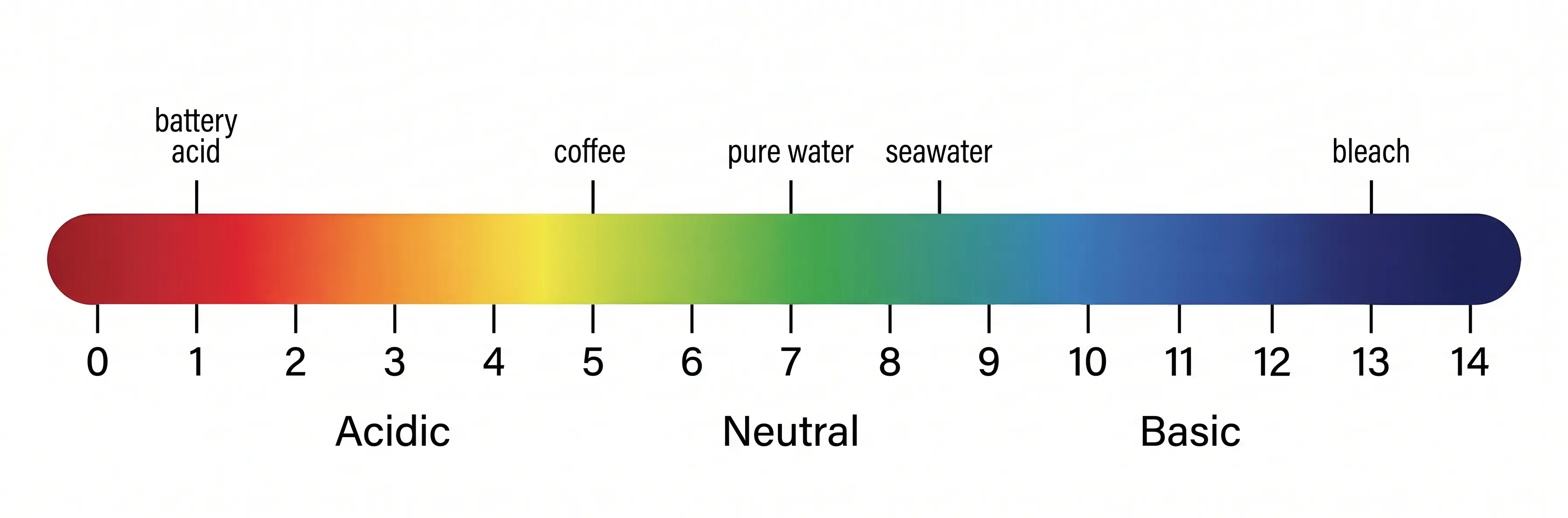
Here's the thing that actually catches people off guard when they first genuinely sit with this. That scale is not linear. Not even close. It's logarithmic, which sounds like a footnote, but it completely rewires how you have to think about these numbers. pH 5 isn't slightly worse than pH 6. It's ten times more acidic. pH 4 is a hundred times more acidic than pH 6. A hundred times. So when a reef hobbyist is visibly stressed about their tank dropping from 8.2 to 7.9 overnight — they're not overreacting. That drop looks tiny written out. In actual chemical terms, it absolutely is not.
And here's a fun historical footnote that most people don't know. All of this came out of a brewery. In 1909, a Danish chemist named Søren Peder Lauritz Sørensen was working at the Carlsberg Laboratory — yes, that Carlsberg, the one that makes beer — and he was trying to work out how hydrogen ion concentration was affecting enzyme activity during fermentation. He needed a better way to write very small numbers and developed the logarithmic scale we still use today. Over a hundred years later, and nothing's replaced it. The "p" comes from the German word Potenz, meaning power — as in powers of ten. Every pH value has a mathematical exponent buried inside it.
The pH Formula — How pH Gets Calculated
One equation is doing almost all of the work here:
The [H⁺] is the hydrogen ion concentration in mol/L. Taking the negative log flips the relationship — higher ion concentration pushes pH down toward acidic, lower ion concentration pushes pH up toward basic. Once that backwards relationship properly clicks — like actually makes sense rather than just being a rule you memorize — reading a pH scale starts to feel natural rather than backwards.
Going the other way — figuring out [H⁺] from a pH you already have:
For working with hydroxide ions:
And the equation that connects both sides at 25°C:
That isn't just a rule somebody put in a chemistry textbook because it seemed convenient. It comes directly from how water behaves at that temperature. In pure water at 25°C, [H⁺] multiplied by [OH⁻] always equals 1×10⁻¹⁴ — that constant is called Kw, the ion product of water. Take the negative log of both sides of that expression, and pH + pOH = 14 just falls straight out. Nobody invented that relationship. Water did.
Quick reference table for which formula to reach for depending on what's already known:
| Known Value | How to Find pH |
|---|---|
| [H⁺] concentration | pH = −log[H⁺] |
| [OH⁻] concentration | pOH = −log[OH⁻], then pH = 14 − pOH |
| pH directly | Already have it — work everything else from it |
| Mixed solutions | Mole balance across the full combined volume |
How to Use This pH Calculator
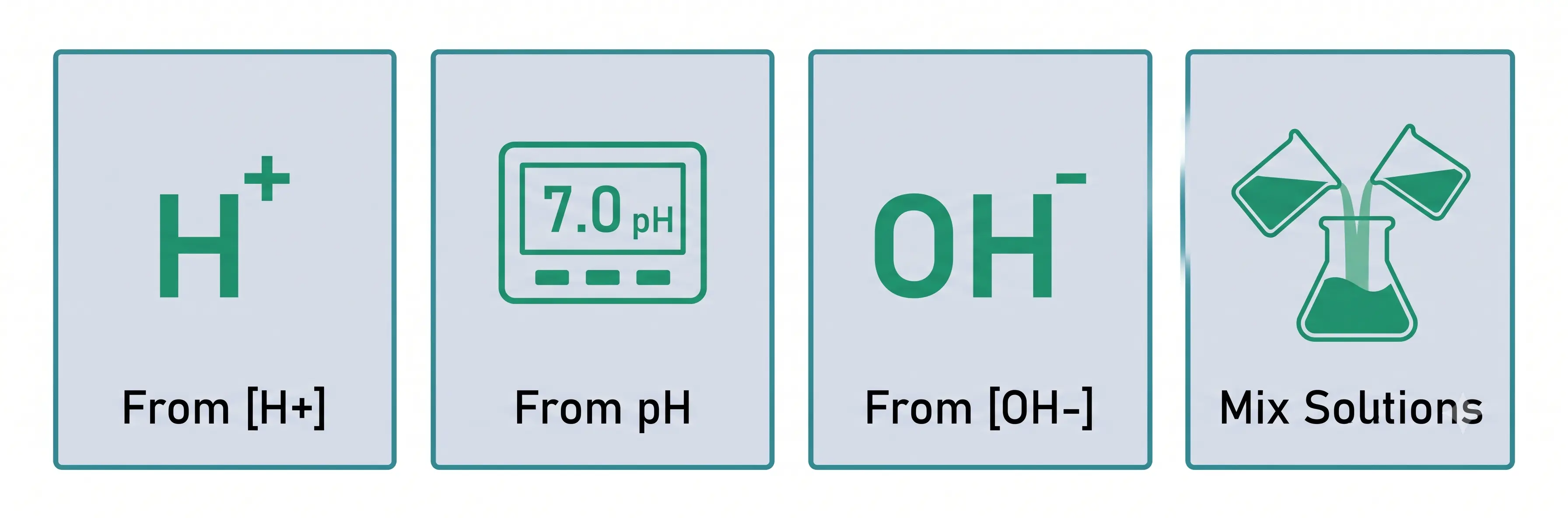
Four tabs. Each one starts from a different place. Here's what each actually does.
Tab 1 — From [H+] Concentration
Type in the hydrogen ion concentration to calculate pH from hydrogen ion concentration, pick a unit — mol/L, mmol/L, or µmol/L — and press Calculate. The tool runs pH = −log[H⁺] and hands back pH, pOH, [H⁺], [OH⁻], a classification of the solution, the litmus indicator color it would produce, and a marker showing where the result lands on the visual pH scale.
Worked example: enter [H⁺] = 1×10⁻⁴ mol/L. You get pH 4.00, pOH 10.00, acidic, litmus turns red.
Tab 2 — From a Known pH Value
Sometimes you've already got the pH reading, and what you actually need are the ion concentrations sitting underneath that number. Enter the pH value, choose a display unit, and this pH and pOH calculator runs [H⁺] = 10⁻ᵖᴴ, then automatically works out pOH and [OH⁻] from there. Worth bookmarking alongside the Khan Academy explainer on pH and pOH if you're working through the theory at the same time.
Worked example: enter pH 9.5, and you get pOH 4.5, [H⁺] = 3.16×10⁻¹⁰ mol/L, [OH⁻] = 3.16×10⁻⁵ mol/L — basic, litmus turns blue.
Tab 3 — From [OH-] Concentration
When you're coming at this from the base side rather than the acid side, this tab is the right starting point. Enter [OH⁻], and the tool calculates pOH = −log[OH⁻] first, then converts to pH = 14 − pOH. You get back the same four output values as with the other tabs.
Worked example: [OH⁻] = 0.01 M. You get pOH 2.00 and pH 12.00 — strongly basic.
Tab 4 — Mixing Two Solutions
This one is for neutralization and titration scenarios — when you need to know what the resulting pH is after two solutions are combined. Enter the type, value, and volume for both solutions. The tool runs a full mole balance underneath all of that:
- Adds up the total moles of H⁺ from both solutions
- Adds up the total moles of OH⁻ from both solutions
- Subtracts them to find whichever ion is left in excess
- Divides that excess by the total combined volume to get the resulting concentration
- Calculates pH from that using the standard log formula
And here's what makes this tab actually useful — every single step of that mole balance gets written out in the results panel. Not just the final pH answer. The whole path. You can see exactly what happened at each stage and why the result came out the way it did.
Worked example: mix 100 mL of pH 3 with 100 mL of pH 11. The acidic and basic moles largely cancel each other out, and the resulting pH lands close to neutral — exactly where the mole balance calculation says it should end up.
pH vs. pOH — Two Ways of Looking at the Same Thing
Try thinking of pH and pOH like two people standing in different doorways of the same room, both describing what they see. They're talking about the same solution — just approaching the same equilibrium from opposite ends. pH is focused on hydrogen ions and reporting on acidity. pOH is focused on hydroxide ions and reporting on basicity. Change one and the other changes with it, always in the opposite direction, always adding up to 14 at 25°C. No exceptions within standard aqueous chemistry.
To make that genuinely concrete rather than abstract:
- pH 2 → pOH 12. Strongly acidic. Almost no hydroxide ions in the picture at all
- pH 7 → pOH 7. Neutral. Both ion types are sitting at equal concentrations
- pH 13 → pOH 1. Strongly basic. Almost no hydrogen ions left to speak of
General chemistry courses spend most of their time on pH and treat pOH as secondary, which makes sense from a teaching standpoint. But pOH is genuinely more practical in some situations. If you're working with NaOH and know the hydroxide concentration, calculating pOH first and then converting to pH is just the faster route. Why go the long way around? This calculator returns both values automatically every time, so neither conversion has to be done manually.
Where pH Calculations Actually Show Up
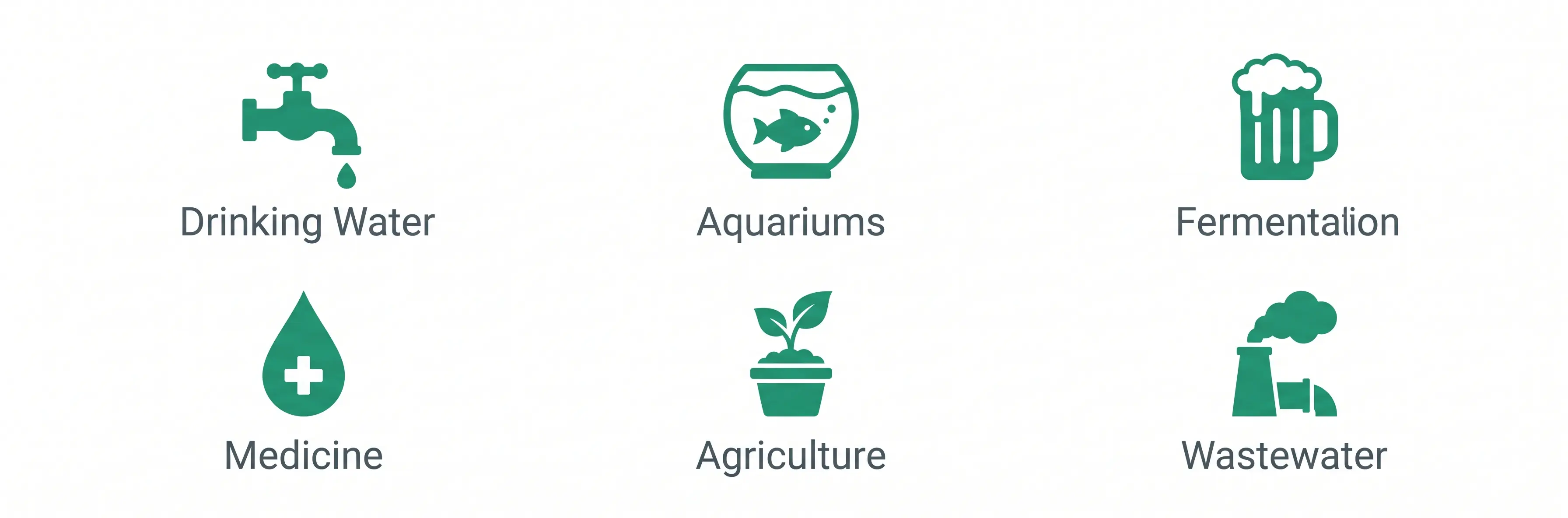
pH math doesn't stay put inside labs and textbooks. It's quietly running through a surprising number of things people deal with in the real world — sometimes without even realising it.
Drinking Water and Water Treatment
The EPA puts acceptable drinking water pH between 6.5 and 8.5 — exactly the kind of check a pH calculator for water treatment makes fast and repeatable — and both ends of that range have real consequences attached to them. Drop below 6.5, and the water becomes corrosive enough to start pulling metals out of pipe walls — including lead in older plumbing systems, which is obviously a serious public health problem and not something you want to be casual about. Push above 8.5, and chlorine starts losing its disinfection power while mineral scale accumulates inside the distribution infrastructure. Treatment engineers aren't doing a single pH check at the end of the process and calling it done. They're monitoring at multiple stages throughout because a mistake there doesn't just mean inconvenience — it means people consuming water that isn't safe.
Aquariums and Reef Tanks
A saltwater reef system needs a pH in the 8.1 to 8.3 range to stay healthy. Freshwater tanks vary quite a bit depending on species, but generally work best somewhere between 6.5 and 7.5. The logarithmic nature of the scale becomes extremely real for reef hobbyists fairly quickly into the hobby. pH 7.8 and pH 8.2 look like a pretty modest gap when you write them side by side. They represent a fourfold difference in actual hydrogen ion concentration. Reef keepers who are adding buffers or kalkwasser without running the calculation first are basically making educated guesses — and a bad guess with a reef tank can take weeks or months to recover from, depending on what goes wrong. Two minutes of math upfront is clearly worth it.
Food Science and Fermentation
Brewers target mash pH between 5.2 and 5.4. That's the range where amylase enzymes perform best and where the finished beer picks up the right flavor profile. Drift outside it, and the mash conversion takes a noticeable hit. Winemakers track pH all the way through fermentation to stay on top of tartaric acid balance and time stabilization correctly. Sourdough bakers check starter pH to confirm the culture is actually acidifying at a healthy rate and not just sitting there. And "pH calculator vinegar" gets searched genuinely often — home fermenters want to verify the acidity in a finished batch before they start bottling it, and that's a completely legitimate thing to want to know before you commit to filling fifty bottles.
Medicine and Pharmaceuticals
Human blood stays between pH 7.35 and 7.45. The carbonate buffer system is working constantly to keep it exactly there and doesn't have a lot of tolerance for deviation. A drop to pH 7.2 is metabolic acidosis. A rise to 7.6 is alkalosis. Both of those are medical emergencies, not minor inconveniences. In pharmaceutical work, buffer pH calculations tell you whether a drug formulation is going to stay chemically stable in storage and whether it'll actually be absorbed correctly once it enters the body. IV solutions go through pH verification as part of manufacturing quality control before they're ever near a patient. That verification isn't optional.
Agriculture and Soil Science
Most crops do their best between pH 6.0 and 7.0. Inside that window, nitrogen, phosphorus, and potassium are in forms plant roots can actually take up and use. Step outside it and things start locking up chemically in ways plants genuinely can't work around — phosphorus binds into insoluble compounds in acidic soil, iron and manganese become unavailable in alkaline conditions. Farmers and agronomists calculate lime or elemental sulfur amendment rates based on current soil pH and the specific target for whatever crop is going in that season — and a scale calculator can help convert between unit formats when working out amendment quantities. Getting that calculation wrong shows up at harvest time.
Industrial Wastewater
Before industrial effluent can legally leave a facility, it typically has to hit a specific pH range to satisfy environmental regulations. The calculation tells process engineers how much sodium hydroxide or hydrochloric acid is needed to treat a given volume of wastewater to get it there. Undershoot, and there's a compliance violation. Overshoot and reagent gets wasted while the pH swings past the target in the wrong direction — running a percent decrease calculator on reagent costs quickly shows what that waste adds up to over time. Both outcomes are problems — one regulatory, one financial — and neither is great.
Worked pH Calculation Examples
Four problems worked all the way through from start to finish. Running these through the calculator above is a solid way to check the numbers and get comfortable with how each input tab actually behaves.
Example 1 — How to Calculate pH of a Strong Acid (HCl)
What's the pH of 0.025 M HCl?
HCl is a strong acid and fully dissociates in water, so [H⁺] equals the molar concentration directly — no partial dissociation to worry about. [H⁺] = 0.025 M.
Strongly acidic.
Example 2 — Strong Base (NaOH)
What's the pH of 0.01 M NaOH?
NaOH fully dissociates too, so [OH⁻] = 0.01 M. Use that to calculate pH from pOH using pH = 14 − pOH.
pH = 14 − 2.00 = 12.00
Strongly basic.
Example 3 — Concentration in µmol/L
[H⁺] = 500 µmol/L. What's the pH?
This example walks through how to find pH from a concentration given in µmol/L. Convert to mol/L first — this step gets skipped more often than it should: 500 µmol/L = 5×10⁻⁴ mol/L.
Mildly acidic.
Roughly the same territory as black coffee or acid rain.
Example 4 — Working Backward from pH
Ocean surface water sits at around pH 8.2. Find [H⁺] and [OH⁻].
pOH = 14 − 8.2 = 5.8
[OH⁻] = 10⁻⁵·⁸ = 1.58×10⁻⁶ mol/L
Tips for Getting Accurate Results — Common pH Calculation Errors to Avoid
Most pH calculation errors come back to the same small set of avoidable mistakes. These are the ones that show up again and again.
Sort Out Units Before Anything Gets Entered
The calculator takes mol/L, mmol/L, and µmol/L. If your source data is in mg/L or µg/L, it needs to be converted to molar concentration before it goes anywhere near the input field. Entering the right number in the wrong unit is honestly the most common reason results come out looking completely wrong — and it can be a frustrating one to diagnose if you don't think to check units first.
Use Scientific Notation — It's Supported and Much Safer
Typing 1e-7 takes about two seconds, and it's really difficult to get wrong. Writing 0.0000001 and counting those zeros correctly every time is genuinely error-prone. Both inputs give the same result so there's no reason not to use the one that's harder to mess up.
Weak Acids and Bases Are Fundamentally Different from Strong Ones
This calculator works from actual [H⁺] as its input, not the molar concentration of a compound. This is especially important for weak acid pH calculation — weak acids like acetic acid only partially dissociate in water, which means the acid's molarity and the [H⁺] it actually produces in solution are two completely different numbers. You have to solve the Ka equilibrium expression first to find real [H⁺], and then that value goes into Tab 1. Just entering the acid's molarity directly is one of the most common mistakes people make, and it gives you the wrong answer every time — not approximately wrong, actually wrong.
Temperature Has More Impact Than Most People Expect
pH + pOH = 14 is tied specifically to 25°C because that's the temperature where Kw = 1×10⁻¹⁴. At 37°C — normal human body temperature — Kw shifts and pH at body temperature sits around 6.8, not 7.0. For standard lab work and coursework, 25°C is the assumed baseline, and that's fine. But for anything clinical or physiological, that difference is genuinely relevant.
In the Mix Tab, Both Solutions Must Use the Same Volume Unit
The tab accepts both mL and L, but it needs consistency within a single calculation. Enter one solution in mL, and the other in L, and the mole balance gets thrown off by a factor of 1,000. The output will look perfectly formatted and completely plausible. It will be wrong.
When Results Look Strange, Check the Formula Panel First
Every output includes the full step-by-step calculation written out. A wrong input, a unit mismatch, using the wrong tab for the situation — all of those show up clearly in that panel without any guesswork.
Frequently Asked Questions
What is pH, and what does it measure?
pH measures hydrogen ion concentration in a solution on a scale from 0 to 14. Below 7 is acidic, 7 is neutral, and above 7 is basic. The scale is logarithmic, so each full unit step is a tenfold change in actual ion concentration — not a proportional step like on a linear scale. That detail matters more than it might seem at first.
How do I calculate pH from hydrogen ion concentration?
The formula is pH = −log₁₀[H⁺] with [H⁺] in mol/L. When the concentration is a clean power of 10 like 1×10⁻⁵ M, the answer is just 5 — barely needs a calculator at all. When there's a coefficient like 3.7×10⁻⁴ M in front, you do need one, and you get pH ≈ 3.43.
What is the difference between pH and pOH?
pH tracks hydrogen ions and tells you how acidic a solution is. pOH tracks hydroxide ions and tells you how basic it is. At 25°C, they always add up to 14 — raise one and the other drops by the same amount. This calculator gives both values back automatically on every calculation, no extra step needed from you.
What is a neutral pH, and does it change with temperature?
At 25°C, neutral pH is 7 — the point where [H⁺] and [OH⁻] are sitting in exactly equal concentrations. Temperature moves Kw, though, and that shifts where neutral actually is. At 37°C, it's closer to 6.8. Which means blood at pH 7.4 is genuinely basic relative to actual body temperature — even though 7.4 and 7.0 look nearly identical on the standard scale.
Can pH go negative or above 14?
Yes, it can, in extreme concentration situations. Very concentrated acids can push pH below zero, and very concentrated bases can go above 14. These cases fall outside the standard assumptions for dilute aqueous chemistry and mostly come up in industrial or advanced theoretical work rather than everyday lab or classroom situations.
How does this tool calculate pH when mixing two solutions?
It runs a mole balance. Moles of H⁺ and OH⁻ from each solution are calculated separately and then subtracted to find which ion is left in excess. That excess gets divided by the total combined volume to give the resulting ion concentration, and pH follows from the log formula. The entire calculation is written out step by step in the results panel — not just the final answer, but every step.
How do digital pH calculators work compared to physical pH meters?
A physical pH meter puts a glass electrode into a solution and measures the voltage that develops across it, then converts that reading to pH using a calibration curve. An online calculator takes a known value and derives everything else mathematically. One physically measures something unknown in a real solution. The other computes from data you already have. They get used together quite often — meter for the measurement, calculator for follow-up conversions, and problem solving.
Can this calculator be used for soil pH testing?
Not for the initial measurement — that still needs a physical meter or test kit on a soil and water mixture. But if a lab soil extract analysis has come back with an [H⁺] value, putting that into Tab 1 here gives the corresponding pH for cross-checking or verification.
What is the pH of vinegar?
White household vinegar typically sits between pH 2.4 and 3.4, depending on acetic acid content, which is usually somewhere between 4 and 8 percent by volume. Apple cider vinegar tends to range from around pH 3.1 to 5.0. To get a calculated pH from a specific acetic acid concentration, you need to solve the Ka equilibrium expression first to find the actual [H⁺] — then that value goes into Tab 1.
How do I calculate pH without a scientific calculator?
When [H⁺] is a whole power of 10 — like 10⁻³ or 10⁻⁸ — the pH is just that exponent written as a positive number. Genuinely no calculation needed. 10⁻⁶ means pH 6, done. The problem starts when there's a coefficient in front of the power of 10, because then the full logarithm calculation becomes unavoidable. That's exactly the situation where an online pH calculator saves the most time and frustration.
Conclusion
On the surface, pH looks like a simple concept — just a number sitting somewhere between 0 and 14. But the chemistry it describes runs through a genuinely wide range of real situations that matter to people. Drinking water safety. Reef tank stability. Blood chemistry. Drug formulation. Crop nutrient availability. Fermentation quality control. Industrial discharge compliance. It keeps showing up. And because the scale is logarithmic, numbers that look close together on paper can represent very different chemical realities in practice, which is why getting the math right actually matters and isn't just an academic exercise.
This is a pH calculator with formula breakdown on every result that comes out across four input modes. Students can check homework and actually follow the work instead of just copying a number and hoping it's right. Brewers can verify mash chemistry before the kettle goes on — and track how much efficiency has improved batch over batch with a percent increase calculator alongside this one. Water engineers can run quick target checks without pulling out a textbook. Reef hobbyists can calculate buffer doses instead of eyeballing it and hoping for the best. The Mix Solutions tab takes neutralization problems that would eat up several manual steps and handles them in one go. And because the formula panel is always there and always written out fully, you're never just handed a number — you can see exactly where it came from and trace back every step that produced it. If you work across multiple science and math tools, the right triangle calculator is another one worth keeping close — geometry and chemistry problems have a habit of showing up together.
Save this online pH calculator somewhere you can get back to it easily. pH questions genuinely do show up at inconvenient times, and it's a lot better to have something fast and reliable already open than to be scrambling around looking for a formula when you're right in the middle of something else.